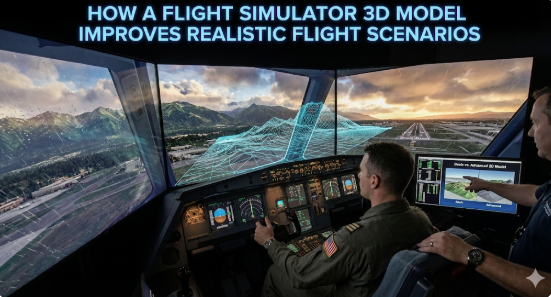
Realism is critical to any effective aviation simulation. Pilots, students, and air traffic controllers are required to hone their aviation skills in simulated environments, measure their skills against their judgment, and prepare themselves for real and demanding flying environments. If simulators are not realistic, they cannot be very effective; so here is a flight simulator 3D model that enables them to have ultra-realistic flight environments.
Modern 3D simulation uses accurate aircraft models, realistic cockpit configurations, and detailed environments to provide a simulation of a wide range of flight conditions that would be unsafe, time-consuming, or costly to practice in a real aircraft.
Developing Accurate Aircraft Representation
Most 3D flight simulation models contribute to increased realism through the depiction of the aircraft itself. Proper scales and proportions, accurate placement of gauges and switches, etcetera, mean that what the pilot sees and interacts with reflects reality.
When the virtual aircraft appears correct and behaves as expected, this develops visual identification, familiar cockpit configuration, and enhances spatial awareness. This can lower pilot workload and enable operators to focus on mastering new maneuvers or decision-making skills.
And this benefit applies equally to muscle memory learning, given that the cockpit architectures are well visualized.
Improving Cockpit Design and Instrument Familiarity
As most pilot attention is within the cockpit at all times airborne, high-precision instrument modeling has a substantial training impact. High fidelity cockpit imagery enables simulators to replicate the following:
- Real instrument placement
- Training on the proper use of references
- The training in utilizing the scanner
- Procedural correctness
Better cockpit fidelity enables pilots to be better able to read instruments more quickly, remember sequence steps more accurately, build effective eye movement, and instill more confidence in the pilot.
Such fidelity is not only important to allow the execution of the basic protocols, but to practice even the more complex procedures, such as IFR flight.
Enhancing Environmental Authenticity and Visual References
The visual environment is heavily relied upon by pilots to navigate and operate aircraft. Traditional visual cues encompass horizon pitch, ground reference, traffic perspectives, and lighting of other aircraft.
Although the above cues generate a good visual framework, real-time imagery and terrain models build upon this by providing the exact physical features of runways, terrain, approach guides, and airport signs. The pilot is thus provided with true features of the surroundings, allowing their integration with aircraft controls.
These richer visual cues add great realism to any phase of flight, but are particularly invaluable to approaches and landings.
Recreating Dynamic Weather and Environment Effects
The weather is unpredictable. A good, realistic simulator should not only be able to reproduce what looks like weather but also how it affects the aircraft’s responses.
Total three-dimensional flight model with high? Fidelity physics can be used for visual animations of weather phenomena, such as fog, rain, turbulence, snow, and clouds, and field experience, as well as observation of those phenomena combined with the effects on actual aircraft behavior.
Familiarisation with understanding, weather, and environmentally driven aircraft responses through simulation prepares pilots who are better armed for real-world situations.
Facilitating Complex and Infrequent Flight Events
Scenarios that are most critical, but least exercised, include abnormal and emergency situations. Power failure, equipment malfunction, shift of wind, crash, and landings are not regularly exercised.
Real 3D visualisation and simulation allow for visual and functional reproduction of these events. Pilots can get a glimpse of small cues that foreshadow system failures, such as indications in the instruments or changes in the environment.
To make these scenarios more realistic for pilots to practice, this way, pilots will actually respond correctly in real life.
Growing Situational Awareness
As visual information is accurately described, pilots develop essential awareness of their situation: they can judge distances, altitudes, relative positions, and rotations according to what they see.
This skill improves the parameter estimate ability and helps pilots operate with confidence in visual approaches and even more challenging situations and traffic.
Enhanced situation awareness leads to increased operational safety.
Supporting Scenario, Based Learning
A contemporary training goal is to shift away from memorized maneuvers to scenario-based, detailed knowledge of many interacting factors (weather, other air traffic, systems failure, navigation, etc.).
Using 3D graphics with high enough realism, instructors should be able to generate many scenarios flowing this way, and which would drive natural reactions of a pilot.
This aspect makes training scenarios more realistic; the more realistic it is, the more it can directly equate with capability in the real world.
Close the Gap Between Simulator and Reality
The arguably strongest reason for investing in new 3D aircraft models is to preserve the simulator experience in the real aircraft.
With the realistic visuals, responsive control, and aware flight behavior, this transition between projects is relatively easy.
Pilots produced in such systems become less flight-ready throughout the range of machinery and work.
This is useful, especially in the transition of pilots from one aircraft type to another.
Evaluating Performance More Precisely
More true-to-life visual scenarios help trainers evaluate pilot performance and knowledge more accurately. With correct visuals, trainers can directly record and analyze pilot responses to visual approaches and cockpit situations.
This presents a more practical review and more usable advice.
Get the Most Out of Simulation Investment
3D models should be modeled well in order to look realistic. Assets with low-level detail in avionics, wrong color schemes, or glitched assets have a negative impact on the simulation.
That‘s where professional 3D modeling services come into the picture. Dependable design teams help simulation providers create and refine hyper-precise 3D products.
A firm understanding of 3D pays dividends in easier simulation platforms and operation, with added benefits of lower overhead of adapting to new training needs.
To visualize the long-term value, these resources have broad reuse possibilities.
Conclusion
Simulation effectiveness in aviation depends on the reality of it. Features such as realistic 3D flight models improve simulation by creating vivid representations of vehicles and cockpit systems, familiar scenarios, and difficult situations, increasing decision-making, scenario, situation, muscle memory, and skill transfer.
Under the guidance of professional modeling experience, however, even the complex simulation can become practically indistinguishable from real operation, and this is especially valuable when preparing pilots for seldom-tested but high-consequence scenarios. High-quality models such as these have immense potential for future commercial, military, and private pilot instruction.
