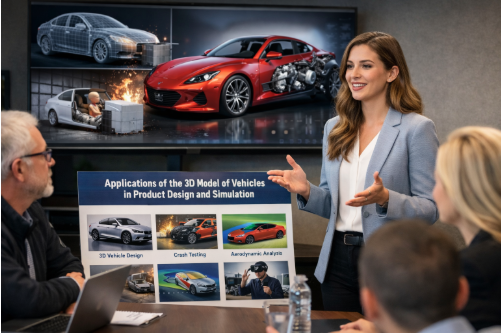
Vehicle development is one of the most challenging domains of product design, with very tight requirements in terms of performance, safety, and regulations. From conceptual drawings to advanced testing and validation, all aspects have to be right and informed.
Digital solutions have now emerged as the solution to these requirements, allowing designers to visualize, test, and validate designs before actual production. In this domain, the 3D representation of vehicles has become an essential part of modern product design and simulation.
Concept Development and Design Visualization
The first phase of development is associated with the concept of converting ideas into design concepts. Digital models of vehicles help designers and engineers in understanding proportions, styling, and shapes in three dimensions, as compared to two-dimensional sketches.
This will enable stakeholders to view designs more clearly, respond faster, and come to a consensus on direction before investing resources.
Component and Assembly Design Details
Cars consist of thousands of components that interact with each other, from the outside to the mechanics. Digital modeling enables the definition of each component and its relationship with the assembly.
Engineers can analyze the interaction of components with each other, point out possible interference, and check the correct clearances. All this information is useful for better system integration, such as powertrain, suspension, and safety systems.
Engineering Simulation and Analysis Support
Simulation is a major application of digital car models. Engineers apply digital models to test real-world performance without having to depend on physical models. Structural analysis, aerodynamics, heat analysis, and motion simulation can be done on digital models.
With a good 3D model of vehicles, it is possible to test how the design will respond to stress, air flow, heat, and motion. This will help in optimizing the design and making it safe.
Aerodynamics and Performance Optimization
Aerodynamics is an important factor in the efficiency, stability, and performance of vehicles. Digital models enable engineers to simulate the flow of air around the vehicle and calculate drag, lift, and turbulence.
Through the digital refinement of shapes and surfaces, it is possible to enhance fuel economy, noise reduction, and handling performance. These improvements can be achieved much more effectively and economically through simulation processes than through wind tunnel testing.
Virtual Prototyping and Design Validation
Computer models of the vehicle assist in understanding assembly methods, maintainability, and integration.
This method will decrease the number of prototypes that need to be physically created. Once the physical prototypes have been created, there is a greater chance of success on the first try.
Improving Safety and Compliance Testing
The safety norms required for vehicles are very tight, and there is no room for negotiation regarding this parameter. Digital modeling is employed for safety analysis, which includes crash simulation, deformation analysis, and analysis of occupant protection.
Engineers can use virtual testing to analyze scenarios for weaknesses before actual testing. This is important for success in regulatory testing and can save costly redesigns late in the development cycle.
Manufacturing Planning and Process Optimization
In addition to design and simulation, digital car models are also important in the area of manufacturing. Engineers can simulate assembly sequences, tooling access, and production processes based on accurate digital data.
This foresight enables the early detection of potential problems in the manufacturing process, which enables modifications to be made even before the manufacturing process starts.
Customization and Variant Development
The current automotive market requires personalization and different models based on common platforms. Digital models are easier to handle when variations are involved.
Engineers can add or modify configurations, dimensions, or features while keeping the same structure. This allows for the quicker development of new models and trims without having to develop new vehicles from scratch.
Integration with Advanced Visualization and Marketing
Besides engineering, digital models of vehicles can also be used in visualization, such as in presentations, reviews, and marketing. High-quality images can be used in the communication of design intent to non-technical people, investors, and consumers.
Some organizations also make use of 3D game art outsourcing services in order to improve the visual quality of the presentation or simulation. Such organizations possess a high level of expertise that can be leveraged.
Long-Term Value Across the Product Lifecycle
Digital models of vehicles can also be applied for other purposes apart from the initial design process. Digital models are applied in the planning of vehicle maintenance, upgrades, and redesigns. Digital models of vehicles can be applied to solve problems or improve vehicles at various stages of their life cycle.
This ensures that the knowledge of design is retained and can be reused.
Conclusion
Accuracy, efficiency, and informed decision-making are the need of the hour in the present era of car development. The 3D model of vehicles has a significant role as it helps in design visualization, engineering simulation, performance optimization, and manufacturing planning. Digital models of vehicles help in risk reduction, cost reduction, and fast-track development. Whether it is development or optimization with the help of 3D game art outsourcing services, it is the need of the hour to invest in efficient vehicle modeling processes to develop quality products in the automotive industry.
